An Extremadura road trip: from Jerez de los Caballeros to Hervás Castle via cathedrals and churches
275 km from south to north through Extremadura: from the baroque of Jerez de los Caballeros to the views of Hervás, via Badajoz, Cáceres, Garrovillas and Coria.
In this article
Some routes are travelled with your eyes on the landscape, and others with your gaze turned upwards, towards towers, vaults and altarpieces. This journey through Extremadura has a bit of both. It's a 275-kilometre drive that begins in the south of the province of Badajoz and ends in the north of Cáceres, in the foothills of the Sierra de Gredos. Along the way, six stops that tell centuries of history: a baroque church bursting with colour, two cathedrals that share their see with others, a Gothic church still very much alive in its town, and a medieval fortress turned into a church.
Before you set off: planning the route
The route follows a logical south-to-north order, with legs ranging between 30 and 84 kilometres, so no day is exhausting behind the wheel. It can be done over a long weekend, although if you want to enjoy the historic centres at a leisurely pace, ideally spread it over three days.
The stops, in order, are:
- Church of San Bartolomé (Jerez de los Caballeros)
- Cathedral of San Juan Bautista, Badajoz (64.2 km)
- Co-Cathedral of Santa María, Cáceres (84.1 km)
- Church of San Pedro (Garrovillas de Alconétar) (30.8 km)
- Coria Cathedral (29.8 km)
- Hervás Castle (66.1 km)
As for when to go, there's no debate: spring and autumn, from April to June and from September to October. Summers in Extremadura are extremely hot, and strolling around stone squares at midday in July is not the best idea. If you have no choice but to travel in summer, make the most of the early morning and late afternoon for exploring on foot.
Jerez de los Caballeros: baroque that dazzles the eye
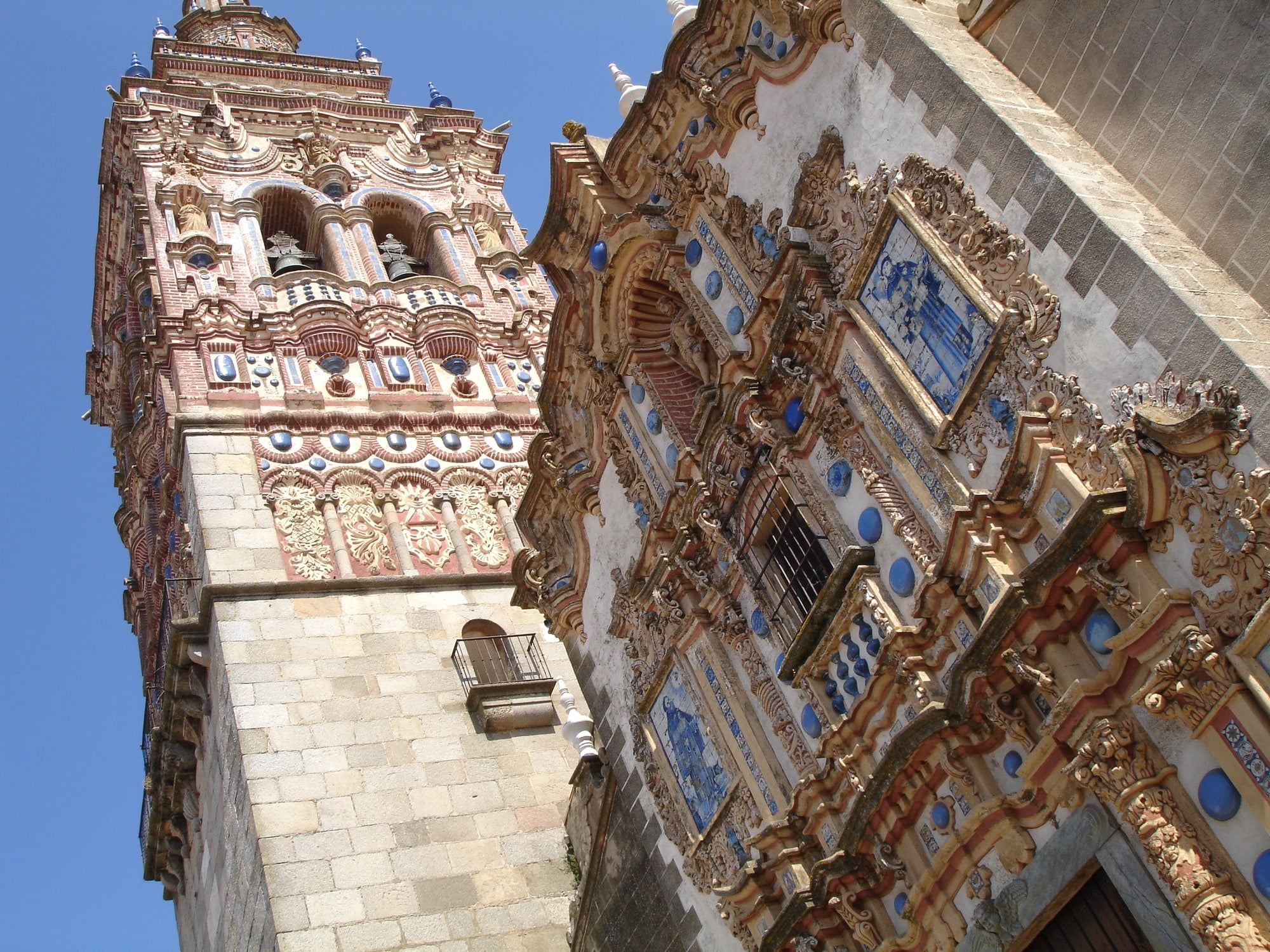
The route gets off to a strong start. Jerez de los Caballeros is a Templar town in the south of Badajoz, declared a historic-artistic site and known for its four baroque towers of brick, plaster and glazed ceramic that dominate the townscape. It deserves an unhurried stroll in its own right, so don't treat it merely as a starting point: give it at least a morning.
Among its highlights is the Church of San Bartolomé, and the first thing that strikes you is the colour. This baroque parish church has earned its fame for its abundant, richly nuanced decoration, the kind that makes you stop in your tracks. The baroque, with its love of ornament and visual effect, expresses itself here without restraint. In 2013 it was declared a Bien de Interés Cultural, the highest level of heritage protection in Spain. Set aside time to take in its details: it's this ornamental richness that gives it its character.
Badajoz: the cathedral that governs an archdiocese
64 kilometres on lies Badajoz and, at its heart, the Cathedral of San Juan Bautista. It stands in the Plaza de España, the city's central square, and is the natural reference point for starting any walk around the town centre.
Its official name, Holy Metropolitan Cathedral Church of Badajoz, already hints at its rank: it is an archiepiscopal see and the seat of the Archdiocese of Mérida-Badajoz, which symbolically unites two of the region's great cities. There's a curious fact that links it to the rest of the trip: together with the cathedrals of Coria and Plasencia, Badajoz Cathedral was a founding member of the Ciudades Catedralicias (Cathedral Cities) association, since joined by fifteen other Spanish cathedrals. In other words, on this route you'll visit two of its three Extremaduran founders.
Cáceres: stone, World Heritage and a curious prefix
The longest leg, 84 kilometres, takes you to Cáceres. Anyone exploring its monumental old town, declared a UNESCO World Heritage Site in 1986, sooner or later ends up in the Plaza de Santa María, home to the Co-Cathedral of Santa María, the city's most important Christian church.
What we see today was built mainly between the 15th and 16th centuries, in a late Gothic style that dominates the whole. But look closely: Romanesque elements survive from an earlier church dating from the reconquest of the town in the 13th century, along with Renaissance additions proving that work carried on as tastes changed.
Its origins were modest: in the Middle Ages it was one of the town's four parish churches, and it was not until 1957 that it was raised to the rank of co-cathedral of the Diocese of Coria-Cáceres. Since then it has shared the episcopal see with Coria Cathedral, hence that prefix that surprises so many visitors. It has also been a Bien de Interés Cultural since 1931, decades before UNESCO recognised the ensemble surrounding it.
Garrovillas de Alconétar: a Gothic church with a life of its own
Just 30 kilometres further on, the route heads into village Extremadura. In Garrovillas de Alconétar, the Church of San Pedro is one of the landmarks of local heritage: a 15th-century church, mainly Gothic in style, offering a fine window onto late medieval religious architecture.
The lovely thing is that it isn't a monument frozen in time. It still functions as a parish church and, together with the Church of Santa María de la Consolación, the town's other great church, forms a single parish within the Diocese of Coria-Cáceres. That a village should have two churches of this calibre speaks volumes about its importance in the past. The advice is clear: combine both on a stroll around Garrovillas to understand how religious life has been organised here for centuries.
Coria: two and a half centuries in the making
Another 30 kilometres brings us to Coria, the diocese's shared see. The Cathedral of Santa María de la Asunción keeps its real treasure inside. The 18th-century high altarpiece features carvings by Alejandro Carnicero, and the main chapel is closed off by a grille worked in the 16th and 18th centuries. In the choir, don't miss the Mudéjar walnut choir stalls from the 15th and 16th centuries, protected by an early Renaissance screen.
Look out too for the bishops' tombs: that of Pedro Ximénez de Préxamo is the work of Diego Copín de Holanda, and that of García de Galarza is by Lucas Mitata. Rounding off the visit are the 18th-century Altarpiece of the Relics, the 17th-century altarpiece of San Pedro de Alcántara, and a remarkable collection of painting, sculpture and silverwork.
The building was begun in 1498 and not completed until around 1748. That's why its transitional Gothic sits alongside Plateresque additions to designs by Pedro de Ybarra and a baroque tower by Manuel de Lara Churriguera, today its most recognisable feature. And beneath its walls lies yet more history: this site was successively home to a Visigothic cathedral, the great mosque and a Romanesque cathedral.
Hervás: finishing on high
The final leg, 66 kilometres, climbs to the north of Cáceres, into the foothills of the Sierra de Gredos. In Hervás, the castle isn't quite what you'd expect: its remains are bound up with the Church of Santa María de Aguas Vivas, built on the foundations of the old fortress, and many people call both by the same name.
The defensive structure dates back to the 13th century and occupies the highest point in the village, ideal for keeping watch over the surroundings. Today that position is a reward: you reach it after climbing steep streets, so wear comfortable shoes. At the top, take your time to admire how the village nestles against the mountains. It's the perfect finale: a medieval fortress turned church, a summary of how buildings change purpose over the centuries, and of how this route, from tower to tower, tells the story of Extremadura.
Article written with the help of artificial intelligence based on Wikipedia (CC BY-SA 4.0) and our catalogue, and reviewed by the El Trotamundos Curioso team.