From Las Salesas to the Sagrada Família: a short stroll through Barcelona's churches
A 640-metre walk through Barcelona linking Joan Martorell's masterpiece, Las Salesas, with Gaudí's forest of stone at the Sagrada Família.
In this article
Some routes are measured in kilometres and others in centuries of history per metre walked. This one clearly belongs to the second group. In barely 0.64 kilometres on foot, this walk through Barcelona links two churches that were born almost at the same time, at the end of the 19th century, and that tell very different stories today: the church and convent of Las Salesas, the masterpiece of an architect who deserves far more recognition than he gets, and the Sagrada Família, the most visited monument in Spain.
It's a perfect stroll for a relaxed morning or afternoon, and ideal if you'd like to begin your visit to Gaudí's great church with a lesser-known but fascinating architectural appetiser.
The route at a glance
- Stop 1: Church and Convent of Las Salesas, on Passeig de Sant Joan.
- Stop 2: Sagrada Família, 0.64 km from the first stop.
The distance is so short that anyone can manage it without effort, so how long you spend will depend mainly on how much you want to linger at each place. And, believe me, you'll want to.
First stop: the Church and Convent of Las Salesas
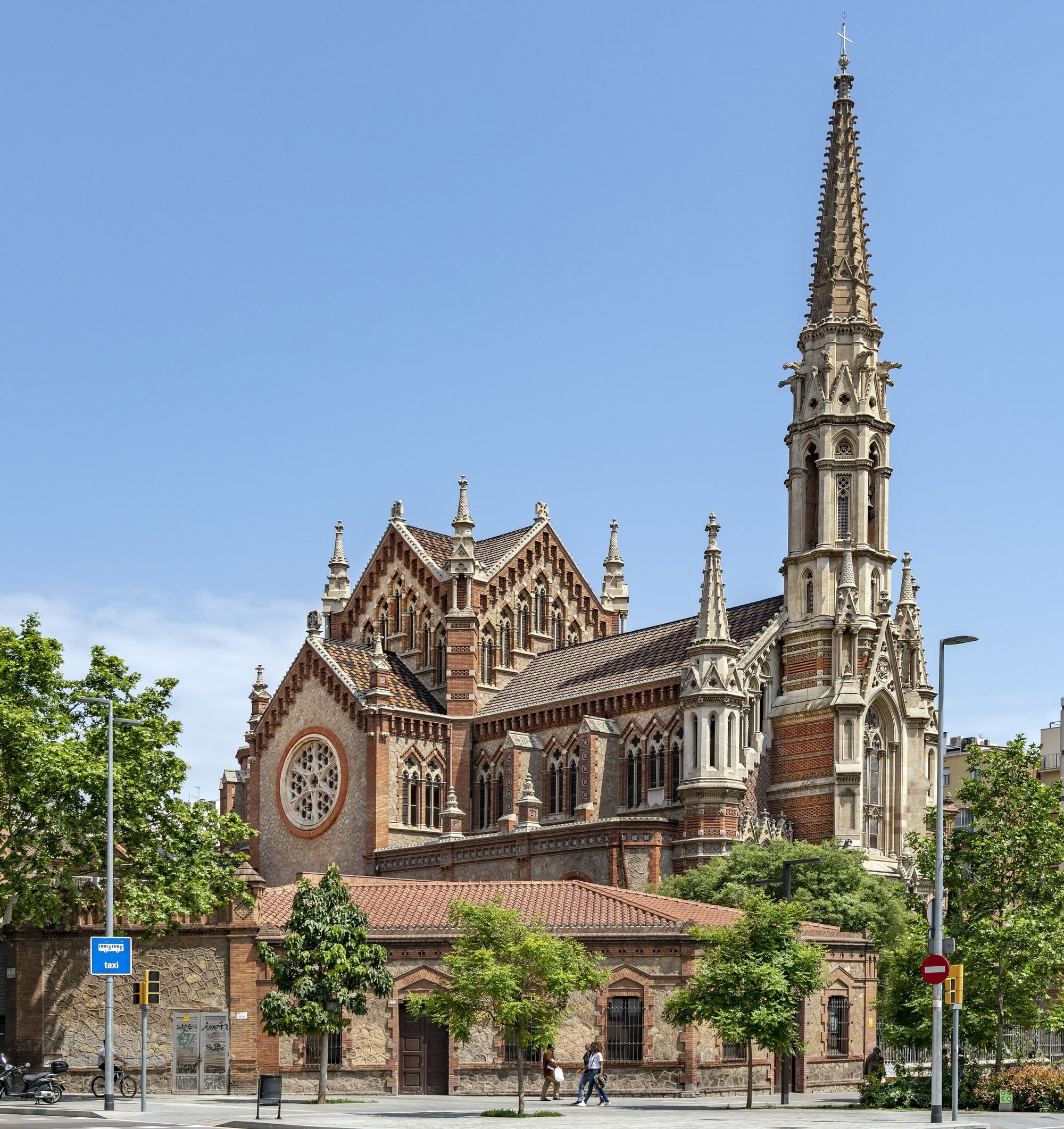
If you stroll along Passeig de Sant Joan, on the stretch between Carrer de València and Carrer d'Aragó, you'll come across one of those ensembles that demand a pause along the way. This is the church and former convent of Las Salesas, designed by Joan Martorell i Montells. This was no minor commission in his career: the project is considered his most important work. That alone makes it worth taking the time to admire it.
An ensemble conceived as a whole
The complex was built to house the Salesian nuns of the Order of the Visitation of Holy Mary. Work began with the convent, construction of which started in 1877, and a little later it was the church's turn, built in just three years, between 1882 and 1885. That speed meant the church and the convent building soon formed a coherent unit, conceived from the outset as a single piece.
Notice this detail as you look at it from the boulevard: these aren't two buildings that just happen to stand side by side, but a project that was planned as one.
Two paths that diverge
Over time, the church and convent have followed different paths without losing their connection. The church is still a place of worship and is today the parish church of Saint Francis de Sales, so you can go inside and appreciate Martorell's work from within. The former convent, on the other hand, changed its function in 1943, when it became a Marist Brothers school. And so a building created for cloistered life came to be filled with pupils, a curious twist that is part of its story.
A visit to Las Salesas is a good opportunity to discover an architect whose name may be less familiar than those of some of his contemporaries, but whose work has a great deal to say. And there's one fact that makes this route even more interesting: construction of the Las Salesas church began in 1882, the same year that work started on our next stop.
Second stop: the Sagrada Família
After a short walk of just over half a kilometre, you reach Barcelona's star attraction. Stepping into the Sagrada Família is like entering a forest of stone. Gaudí designed its interior with leaning columns that branch out like trees and twist in a helical pattern, a solution as simple as it is strong, which filters the light and envelops visitors.
It's no coincidence that it is the most visited monument in Spain, nor that since 30 October 2025 it has held the title of tallest church in the world.
A work that is still alive
Construction began in 1882 and is still ongoing, which makes a visit something living, a building that keeps on growing. The crypt and apse still retain a neo-Gothic feel, but from there Gaudí gave free rein to his organic style, inspired by the forms of nature and ruled geometry.
From 1915, the architect devoted himself almost entirely to this church, where he brought together everything he had learnt in works such as Park Güell and the crypt of the Colònia Güell. Even so, in his lifetime he saw only the crypt, the apse and part of the Nativity façade completed, with the tower of Saint Barnabas as the only one crowned with its finial. After his death, his assistant Domingo Sugrañes took over, followed later by others.
A church that reads like a book
Every corner of the Sagrada Família holds a religious message. Its three façades tell of the Nativity, the Passion and the Glory of Jesus. The project includes eighteen towers:
- Twelve dedicated to the apostles.
- Four to the evangelists.
- One to the Virgin Mary.
- The central one, dedicated to Jesus, standing 172.5 metres tall.
A tip for your visit: spend some time comparing the façades. The sculptural delicacy of the Nativity contrasts strikingly with the angular austerity of the Passion, the work of Josep Maria Subirachs. They are two radically different ways of telling the same story in stone.
Planning your trip
As this is such a short route, the most sensible approach is to take it at a leisurely pace and save most of your time for the Sagrada Família, whose size and wealth of detail invite a long visit. Starting at Las Salesas has one advantage: it lets you ease into the subject with a more intimate church and then arrive at Gaudí's with a well-trained eye.
Some practical tips:
- The best time to do this route is spring or autumn, although on the coast it can be enjoyed almost all year round.
- In summer, try to avoid the middle of the day and carry water.
- Wear comfortable shoes: although the walk is short, you'll spend quite a lot of time on your feet looking upwards.
- Bear in mind that the Las Salesas church is an active parish, so visit respectfully and avoid disturbing services.
- If you're going to the Sagrada Família on special dates or at weekends, try to arrive early and plan your visit in advance, as being the most visited monument in the country it tends to be very busy.
Two churches, one era
The loveliest thing about this walk is seeing how, at the same moment in history and just a few hundred metres apart, late 19th-century Barcelona was building two such different churches. One was finished in barely three years and is Joan Martorell's great work; the other has been under construction for more than a century and has become the symbol of an entire city. Walking the 640 metres between them is, at heart, a little open-air lesson in architecture.
Full route
Catalonia walking route: Church and Convent of Las Salesas - Sagrada Família →2 stops · 0.64 km, with an itinerary map and navigation.
Article written with the help of artificial intelligence based on Wikipedia (CC BY-SA 4.0) and our catalogue, and reviewed by the El Trotamundos Curioso team.