From Barcelona Cathedral to the Ciutadella: a stroll of legends, geese and fortresses
A walk of just over a kilometre through Barcelona: from the Gothic cathedral of Saint Eulalia to the park that erased Philip V's dreaded fortress.
In this article
Some walks are measured in kilometres and others in centuries. This one clearly belongs to the second group. Barely 1.11 kilometres separate Barcelona Cathedral from Ciutadella Park, a distance you can cover at a leisurely pace in no time, yet this short route takes in a journey stretching from the first Christian basilicas to the revolutions of the 19th century. It's a perfect route for a morning or an afternoon, ideal if you're short on time in the city and want to understand a little more of its character than what you see on a postcard.
The common thread is an intriguing one: we start at a church dedicated to a young martyr who stood up to Roman power and finish on the site of a fortress built to subdue the city itself. Two stories of resistance and memory separated by a pleasant stroll.
The stops on the route
- Barcelona Cathedral: the starting point, in the very heart of the city.
- Barcelona Citadel: 1.11 km from the cathedral, the former military compound turned into a park.
First stop: Barcelona Cathedral and its thirteen geese
Few sights are as unexpected in the centre of a big city as the one awaiting you in the cathedral's Gothic cloister: thirteen white geese wandering among arches and orange trees. This is no decorative whim. The birds commemorate Saint Eulalia, patron saint of Barcelona, who according to tradition herded geese on her family's estate in Sarrià and died aged just thirteen. It's a detail that is at once touching and chilling, and probably the best way to begin to understand this church.
A building built on top of others
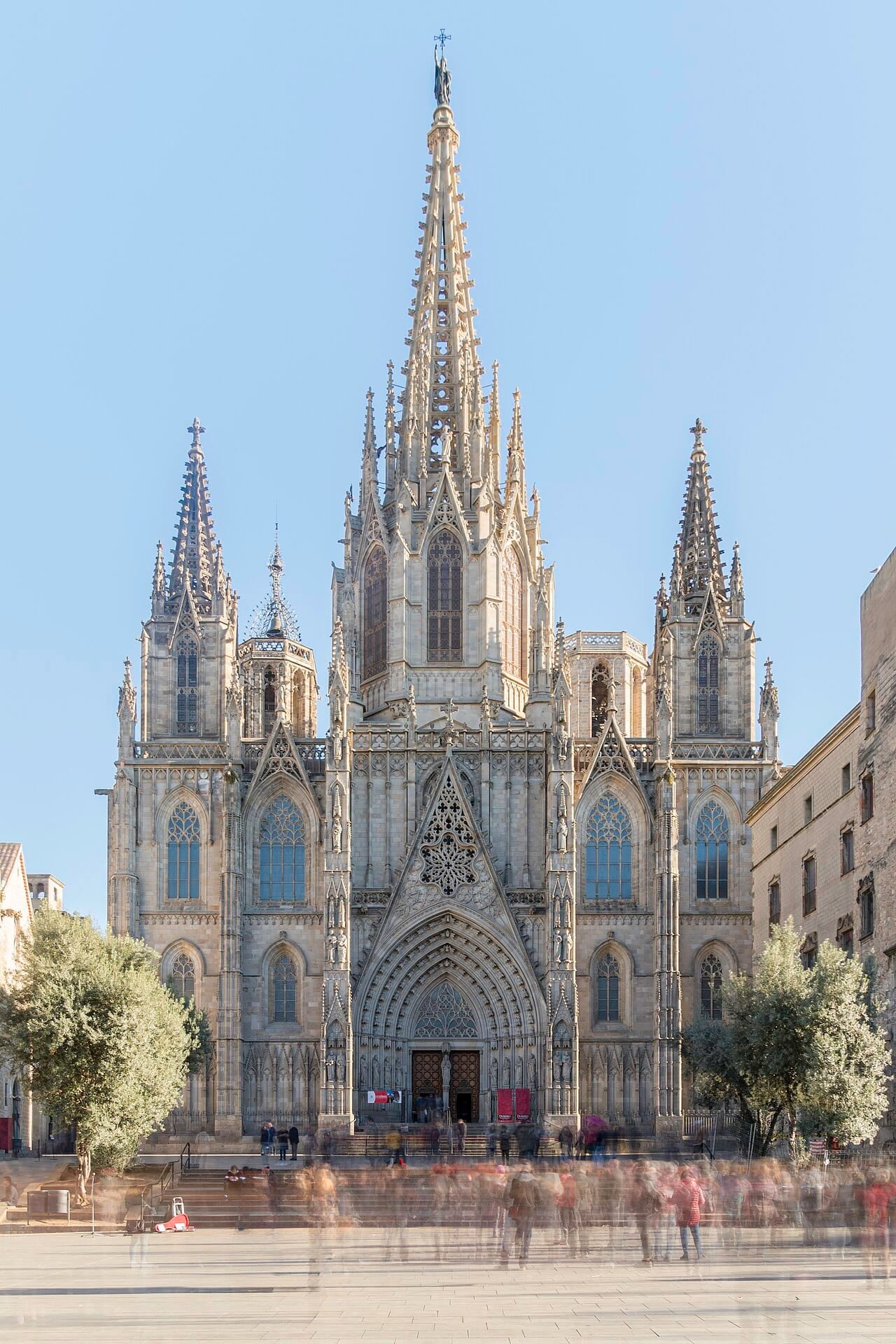
La Seu, as Barcelona's residents call it, is a Gothic building erected between the 13th and 15th centuries. But beneath its stones there is much more. It was built on top of an earlier Romanesque cathedral, which in turn occupied the site of a Visigothic church, preceded by an early Christian basilica. The remains of the latter can be seen underground, within the City History Museum, so if you're interested in seeing, quite literally, the layers of Barcelona's past, it's a visit that complements the cathedral very well.
Before going in, pause for a moment in front of the façade. It's imposing, and at first glance it fits in perfectly with the rest of the complex, but there's a catch: although it follows the same Gothic style, it wasn't completed until the 19th century, long after the rest of the building. Knowing this makes you see it in a different light. What's more, since 1929 the cathedral has been recognised as a national historic and artistic monument.
The legend of Saint Eulalia
The church has been dedicated to the Holy Cross since the year 599, and from 877 onwards it was also dedicated to Saint Eulalia. Her story, as tradition tells it, is not one you'll easily forget. The young woman denounced the persecution of Christians before the Roman governor and, far from being heard, suffered thirteen tortures, one for each year of her life. When she was exposed naked in the forum, a snowfall in the middle of spring is said to have miraculously covered her. She was then thrown into a barrel filled with glass, nails and knives.
With that story in mind, the cloister and its geese stop being a mere curiosity and become a small living tribute. Take your time here: the cloister is one of those spots where the hustle and bustle of the city seems to stay outside.
The walk between the two stops
It's 1.11 kilometres from the cathedral to the Ciutadella, a short, easy walk that lets you take in what you've seen and move from one era to another without even noticing. It's a good moment to let the city carry you along, without fretting about the time. Wear comfortable shoes: although the distance is short, between visiting the cathedral and exploring the park you'll end up walking a good deal more than it seems.
Second stop: the Ciutadella, from dreaded fortress to park
Anyone strolling through Ciutadella Park today might not imagine they are walking on the site of one of the most feared constructions in Barcelona's history. A military fortress once stood here, designed not to defend the city from outside enemies but to watch over it and subdue it from within. That contrast between its origins and the pleasant use it has today is what makes a visit more than just a walk among the trees.
Philip V's punishment
The Citadel was built on the orders of Philip V at the end of the War of the Spanish Succession. Barcelona had ended up on the losing side, and the new monarch wanted to make sure the city remained under control. The fortress thus became a symbol of imposed power, a presence that Barcelona's residents had before their eyes for generations.
If at the cathedral the protagonist was a young woman who defied authority, here the protagonist is authority itself, making it clear who was in charge. It's hard not to notice the contrast between the two stops.
The demolition and what survived
The end came with the revolution of 1868, when the fortress was finally demolished. The demolition was very much a gesture of liberation, but it didn't completely erase the memory of the compound. Three of the buildings inside were spared, and they are well worth seeking out during your visit:
- The chapel.
- The governor's palace.
- The arsenal.
They are the only direct witnesses to what this military complex once was and help you picture the life that went on behind its walls. Tracking them down turns the stroll into a small historical treasure hunt.
A park with a memory
Ciutadella Park was built on the freed-up land in 1888, and its name preserves the memory of the old fortress. Exploring it with this history in mind completely changes the way you see it: the walkways and gardens stand where bastions once rose. It's a good place to end the route, sit down for a while and rest after so many centuries packed into such a short distance.
Tips for planning your visit
The best time to do this route is spring or autumn, when the temperatures are pleasant and walking is particularly enjoyable, although, being on the coast, it's a walk you can enjoy almost all year round. In summer, however, it's best to avoid the middle of the day and to carry water, especially if you plan to spend a good while in the park.
If you're travelling on public holidays or in high season, try to get to the cathedral early: it's one of the most visited places in the city centre, and first thing in the morning you can enjoy it more calmly, especially the cloister. Also set aside some extra time if you want to go down and see the early Christian remains at the City History Museum.
It's a good idea to do the route in the suggested order: start with the dense stone and legend of the cathedral and finish in the open space of the Ciutadella, where your body will welcome a bit of greenery and your mind can go back over everything you've seen. Just over a kilometre, yes, but a memorable one.
Full route
Catalonia walking route: Barcelona Cathedral - Barcelona Citadel →2 stops · 1.11 km, with an itinerary map and navigation.
Article written with the help of artificial intelligence based on Wikipedia (CC BY-SA 4.0) and our catalogue, and reviewed by the El Trotamundos Curioso team.