From Toledo to Almagro: a road trip through the convents, mosques and castles of Castilla-La Mancha
A 121.7 km route linking Gothic and Moorish Toledo with Guadamur Castle and the Convent of the Assumption of Calatrava in Almagro.
In this article
Some routes are all about watching the milometer, while others are best enjoyed at street level. This one, a 121.7-kilometre drive through Castilla-La Mancha, has a bit of both: it starts with a stroll around Toledo's old town, where the first four stops are a stone's throw from one another, then hops over to nearby Guadamur Castle and finishes, after the longest stretch, in Almagro, in the province of Ciudad Real. Along the way lie almost a thousand years of history: a caliphal oratory, the cathedral that many consider the pinnacle of Spanish Gothic, hermitages, convents and a fortress that gives an entire village its character.
Before you set off: how to plan the route
The key is to split the day (or better still, the weekend) into two very different parts. The first is Toledo: the Convent of Santa Isabel de los Reyes and the Hermitage of Cristo de la Vega are barely 1.6 kilometres apart, so the sensible thing is to leave the car parked and explore this part on foot. The second is the open road: 11.1 kilometres to Guadamur and, from there, 109 kilometres to Almagro.
These are the stops, in order:
- Convent of Santa Isabel de los Reyes (Toledo)
- Toledo Cathedral, 0.3 km away
- Mosque of Cristo de la Luz, 0.4 km away
- Hermitage of Cristo de la Vega, 0.9 km away
- Guadamur Castle, 11.1 km away
- Convent of the Assumption of Calatrava (Almagro), 109 km away
The best times to do it are spring (April to June) and autumn (September and October). Summers here are very hot and winters cold, so if you have no choice but to travel in July or August, it's best to do your walking first thing in the morning and late in the evening. Above all, wear comfortable shoes: Toledo's slopes and cobbles are unforgiving.
A general word of advice that applies to several stops: convents and hermitages often still have an active religious life or variable access arrangements, so it's worth checking opening times and visiting options beforehand.
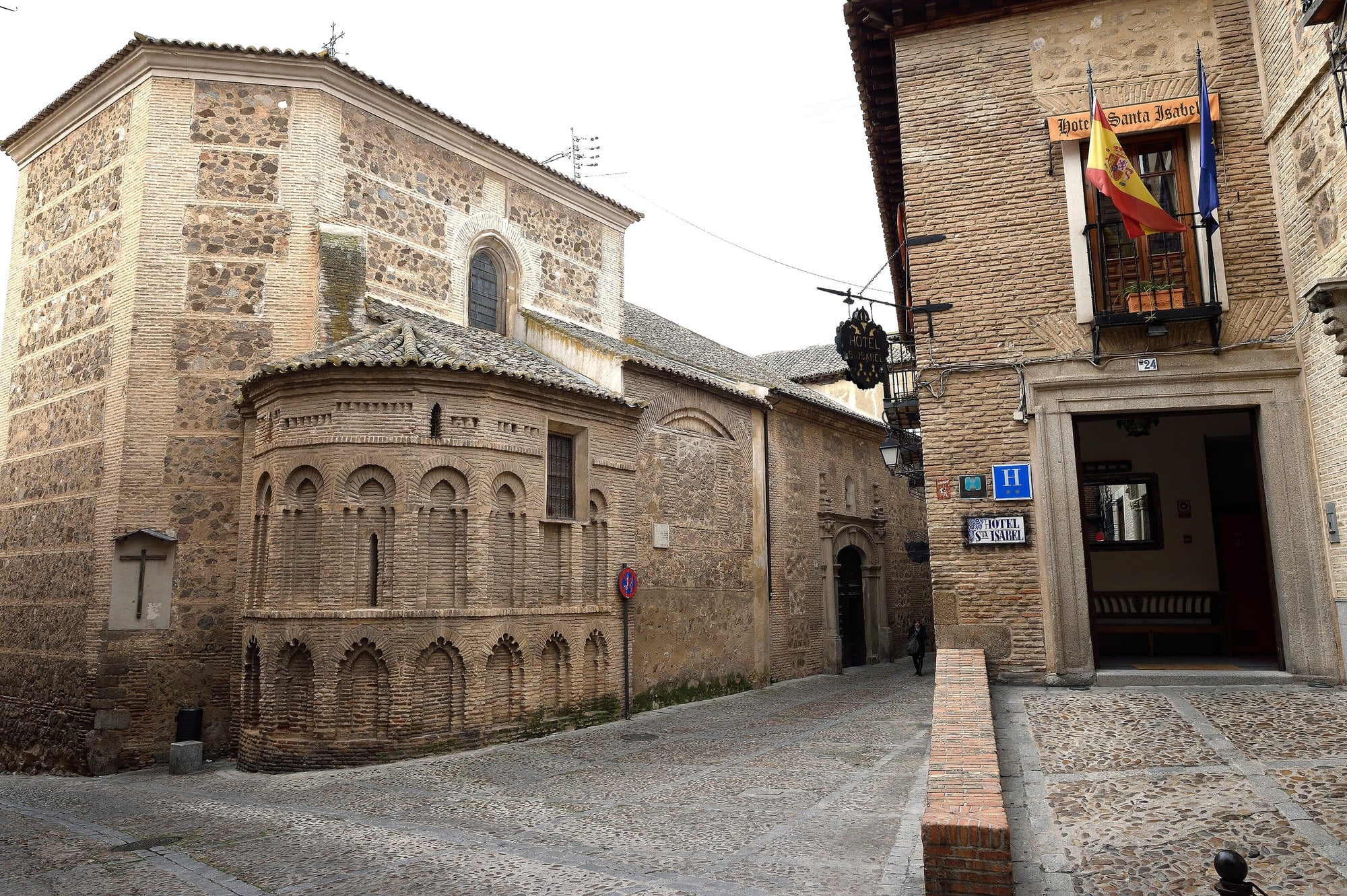
Convent of Santa Isabel de los Reyes: starting away from the crowds
Toledo is a city where almost every corner hides a church, a palace or a convent, and Santa Isabel de los Reyes is part of that dense religious fabric. Starting here has a certain charm: seeking it out is the perfect excuse to leave the busiest routes behind and enter the city through a less obvious door.
Its name, which pairs Saint Isabel with the Monarchs, is intriguing in itself. The best approach is to visit with the attentive eye that every corner of Toledo deserves and let the building speak for itself. If it isn't open to visitors at the time, a stroll around its surroundings is still well worth it to understand that Toledo's riches go far beyond its famous monuments.
Toledo Cathedral: the «Dives Toletana»
Just 300 metres away awaits the main event. Few cathedrals have such an eloquent nickname: since ancient times it has been known as Dives Toletana, «the rich one of Toledo». For some scholars it is the opus magnum of Gothic in Spain, the work in which the style reached its most accomplished expression on the Peninsula.
Its official name is the Cathedral of Santa María, although it is also called the Primate Cathedral of Spain, a title that recalls the historical weight of the see of Toledo. And it's no museum piece: it remains the seat of the Archdiocese of Toledo, a living church that still fulfils the purpose for which it was built.
Its construction is a lesson in patience. Work began in 1226, during the reign of Ferdinand III the Saint, and the Gothic phase was not completed until the end of the 15th century: in 1493, under the Catholic Monarchs, the vaults at the west end of the nave were finally closed. Almost three centuries of work, during which several generations of stonemasons, master builders and patrons shaped a single project.
Take note of the material, too: the cathedral is built from white stone from Olihuelas, in the municipality of Olías del Rey, very close to the city. That brightness of the stone is part of its personality.
Mosque of Cristo de la Luz: the year 999 written on the façade
Four hundred metres away lies one of the most revealing buildings of Moorish Toledo. Of the ten mosques the city once had, Bab al-Mardum is the one that has best withstood the passage of time. Its façade carries its own birth certificate: an inscribed band records that it was built in the year 999, at the height of the Caliphate of Córdoba.
It wasn't a great congregational mosque but a modest oratory beside the Bab al-Mardum gate, which gave it its name. Those who had just arrived in Toledo, or were about to leave, prayed here, and something of that air of transit and contemplation can still be felt in a space of almost domestic proportions.
After the Christian conquest, Alfonso VI granted the building to the Knights of the Order of Saint John, who turned it into a hermitage dedicated to the Holy Cross. In the 12th century, most notably, an apse was added, considered the oldest known example of Mudéjar art. The last flourish of the caliphate and the birth of Mudéjar, all under one roof: few visits sum up the city's history so well.
Hermitage of Cristo de la Vega: simple devotion
We round off the Toledo section with a 900-metre walk to the Hermitage of Cristo de la Vega. Its name offers clues: it is dedicated to Christ and refers to the vega, the low, flat land by the river. Like so many hermitages, it was built more for simple devotion than for display, and that's precisely why it offers a different perspective from the cathedral.
Take your time, look at the building and its surroundings, and bear in mind that Toledo's religious life wasn't confined to its great monuments. It's the ideal place to say goodbye to the city before heading back to the car.
Guadamur Castle: the silhouette that defines a village
Eleven kilometres away, in the Toledo municipality of Guadamur, stands the castle that gives the place its name and personality. This fortification speaks of times when these lands needed walls and towers to defend themselves, and today it remains the village's most recognisable landmark and the reason many travellers make the detour.
The information available is scant, so it's best to arrive without preconceptions: look at its walls, at how it relates to the surrounding houses, and wander the streets for a while. Check visiting options beforehand; even so, admiring its silhouette from outside is reason enough to stop for any castle lover.
Convent of the Assumption of Calatrava: the finale in Almagro
The longest stretch, 109 kilometres, takes us to Almagro, in the province of Ciudad Real. It's a good idea to take a break if you're travelling in the heat. There, among its streets, stands the Convent of the Assumption of Calatrava, a building that is part of the town's landscape.
Its name holds a double clue: the Assumption indicates its dedication, while Calatrava links it to a name closely tied to these lands of La Mancha. To learn more about its history and artistic details, your best bet is to ask on site or at Almagro's tourist office. Check, too, whether you can visit the interior; if it can only be seen from outside, viewing it in its setting helps you understand how convents have shaped the towns of the province.
The best way to round off the route is to make it part of an unhurried stroll around Almagro, letting the day draw to a close at the leisurely pace these lands call for.
Article written with the help of artificial intelligence based on Wikipedia (CC BY-SA 4.0) and our catalogue, and reviewed by the El Trotamundos Curioso team.