From Segorbe to Alicante by car: a Valencian Community road trip of cathedrals, monasteries and castles
170 km by car from Segorbe to Alicante: a Gothic cathedral, a Renaissance monastery, a medieval hermitage and two castles with views.
In this article
Some routes are travelled by gazing at the landscape; others read like a history book. This one, linking Segorbe Cathedral with Alicante's Santa Bárbara Castle over 170.1 kilometres, belongs firmly to the second kind. Running north to south, it crosses the Valencian Community, leaping from Valencian Gothic to the Renaissance, from walls that butt up against a medieval rampart to a crag overlooking the Mediterranean. Six stops, three provinces and seven centuries of history on a trip you can do in one go or, better still, spread over a couple of days.
The route at a glance
- Segorbe Cathedral (Castellón), starting point.
- Monastery of Sant Miquel dels Reis (Valencia), 40.6 km away.
- Convent of Santa Úrsula (Valencia), 2.8 km away.
- Hermitage of Sant Roc de Ternils (near Carcaixent), 41.4 km away.
- Xàtiva Castle, 14.7 km away.
- Santa Bárbara Castle (Alicante), 70.6 km away.
The longest stretch is the last, from Xàtiva to Alicante, so it's worth reaching Xàtiva with energy to spare and saving Alicante's castle for the end of the day or for the following morning.
Segorbe Cathedral: a church that leans on the city walls
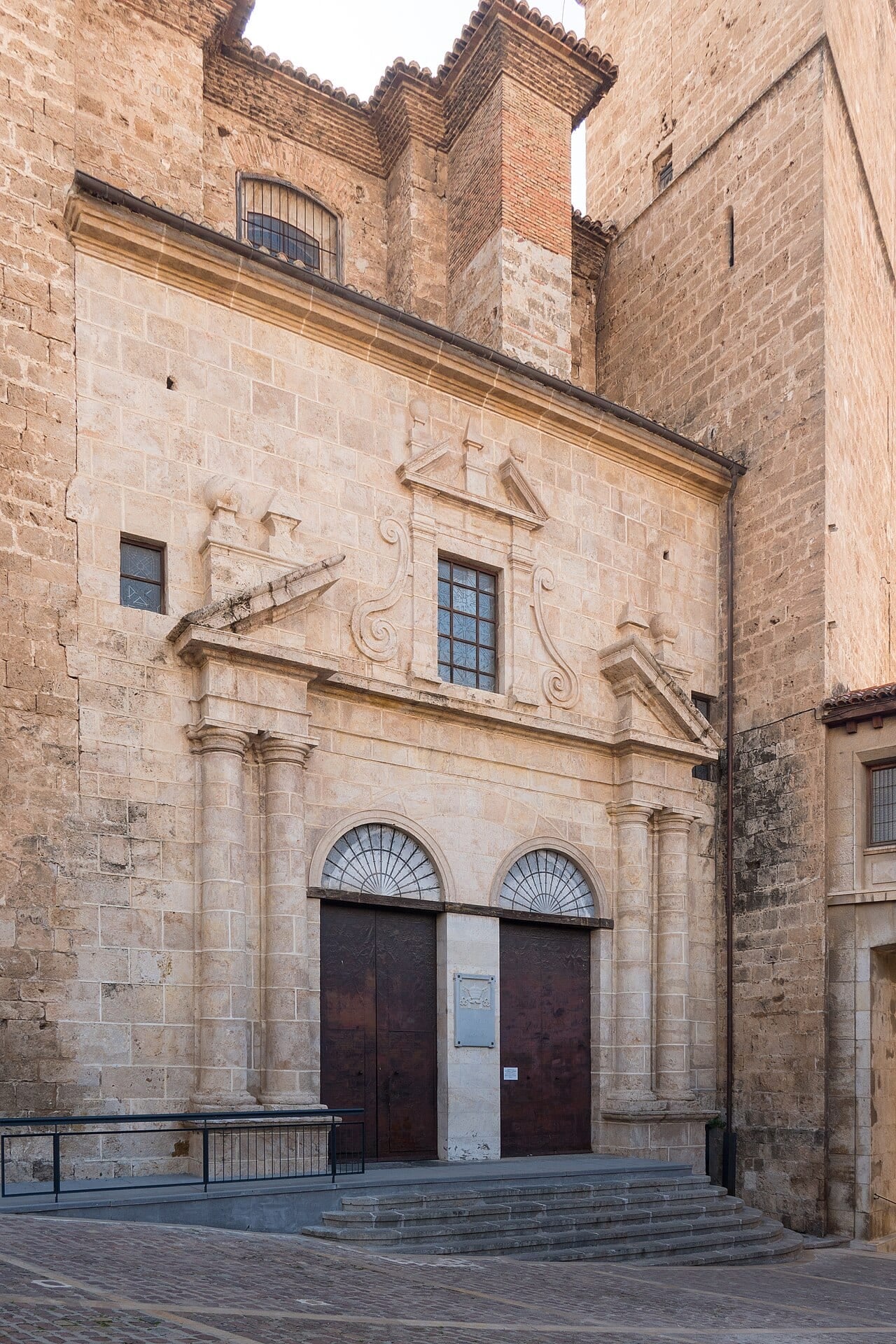
Work began on the Cathedral-Basilica of the Assumption in Segorbe in the 13th century, built against the city wall itself and following the forms of Valencian Gothic. The original structure has not survived intact, but enough traces remain for the observant visitor to mentally reconstruct the first church.
The jewel is the cloister. Its unusual trapezoidal plan is not a whim but a necessity: its builders had to adapt to the irregular line of the wall. The result is one of the rarest cloisters of its kind, and its charm lies precisely in that unadorned simplicity.
It's also worth looking at the west façade, where Gothic remains peek through, and at the load-bearing walls that have held the building up ever since. In some chapels there are rib vaults now hidden from view, witnesses to successive alterations. The Santa Bárbara tower and the bell tower complete that early phase and recall the cathedral's defensive past. Visiting it is, to a large extent, an exercise in reading.
Monastery of Sant Miquel dels Reis: a forerunner of El Escorial
In the Orriols district, somewhat removed from the bustle of central Valencia, stands one of the most ambitious ensembles of the Valencian Renaissance: San Miguel de los Reyes, or Sant Miquel dels Reis. It was founded in 1545 by Ferdinand of Aragon, Duke of Calabria, for the Order of Saint Jerome, on the site of a former Cistercian monastery called Sant Bernat de Rascanya.
The duke wanted more than a convent: a memorial church to perpetuate his memory and a hub of cultural life. This blend of Hieronymite monastery, cultural centre and symbolic pantheon leads some authors to regard it as a forerunner of El Escorial. With that idea in mind, its scale makes more sense, as does the coherence of a Renaissance architecture on which leading artists of the day worked.
After the disentailment it lost its religious function and, for many years, served as a prison, a chapter at odds with its intellectual calling. That calling has since been restored: since 2000 it has housed the Nicolau Primitiu Valencian Library.
Convent of Santa Úrsula: a haven in the heart of the city
Less than three kilometres away awaits a more intimate stop. The Convent of Santa Úrsula, a Catholic religious house in the very heart of Valencia's old town, is one of those buildings that remind you how convent life has coexisted for generations with the rhythm of the city.
Little information is available about its history, so it's best to arrive without preconceptions and with your eyes open. Its location makes it easy to include on a walk around the centre, as a peaceful pause between busy streets. Bear in mind, though, that it is a convent, not a museum. A visit calls for discretion, and it's wise to check beforehand whether you can go inside, as access isn't always guaranteed.
A practical tip: if you leave the car parked, you can combine this stop on foot with other corners of the old town before heading south.
Hermitage of Sant Roc de Ternils: the last trace of a vanished village
A short distance south of Carcaixent stands a small building that preserves the memory of a village that no longer exists. The Hermitage of Sant Roc de Ternils is the oldest building in the municipality and the last vestige of Ternils, a settlement that gradually emptied until it disappeared in the 16th century.
It was originally the village church, built in the 13th century after the Christian conquest and dedicated to Saint Bartholomew. And it was no ordinary church: it was the first Christian parish in the whole of the Huerta de Carcaixent. With depopulation, it was reduced to a hermitage.
It belongs to the so-called Reconquest churches, in an early Valencian Gothic that still breathes Romanesque. It has a single rectangular nave with four pointed arches and a projecting, likewise rectangular, chancel. Outside, look at the buttresses and, above all, the Mudéjar cornice beneath the gabled roof, with two-coloured bricks laid on edge, horizontally and in a sawtooth pattern. The doorway, at the west end, opens with a round arch of large, irregular voussoirs resting on imposts and simple half-columns, topped by a small window. Inside awaits its exposed timber ceiling, the great surprise of the place.
Xàtiva Castle: two fortresses and a coat of arms
Just 15 kilometres later, Xàtiva greets travellers with its castle up on high. Although, in fact, there are two: seen from the town, the Lesser Castle is on the left and the Greater Castle on the right, joined in a single complex facing the Vernisa range. Getting this distinction clear before you climb helps you see it as a pair of complementary fortresses.
Built in the Valencian Gothic style, the castle is so important to the town that it appears on its coat of arms: a tower from which two walled arms extend, each crowned by a castle. Arrive with that image in mind and enjoy watching the heraldic design take shape before your eyes, with the town at your feet.
The climb is fairly steep, so bring comfortable shoes and water, especially on a hot day.
Santa Bárbara Castle: the crag that watches over Alicante
The grand finale comes after 70.6 kilometres. Santa Bárbara Castle crowns Mount Benacantil, right in the centre of Alicante, a 167-metre rocky mass that reaches the very edge of the Mediterranean. From the top you can take in the whole bay and much of the surrounding land, and its strategic value is instantly clear: whoever held the summit kept watch over the sea and the roads.
Before you go up, stop on the beach and look at the mountain: its silhouette resembles a face in profile, the famous «cara del moro» (Moor's face), one of the city's great symbols. Even the mountain's name has a story: some historians derive it from bena (from the Latin pinna, «crag») and laqanti, from Laqant, the Arabic name for Alicante. The crag of Alicante, no less.
Tips for planning the route
- When to go: spring and autumn are the best times for all the stops, away from the heat and summer crowds on the coast.
- Over two days: a comfortable option is to stay overnight in Valencia after the first three stops and devote the second day to Ternils, Xàtiva and Alicante.
- Daylight: save the castles for early morning or the afternoon; the views are better and you avoid the midday sun.
- Check in advance: find out whether interiors can be visited, especially at the convent and the hermitage.
From the walls of Segorbe to Alicante's balcony over the Mediterranean, this route shows that the Valencian Community holds, just a few kilometres from its coast, a history that deserves to be explored at a leisurely pace.
Article written with the help of artificial intelligence based on Wikipedia (CC BY-SA 4.0) and our catalogue, and reviewed by the El Trotamundos Curioso team.