From the Pulchra Leonina to the castle: a walk through the historic heart of León
Half a kilometre on foot through León linking the Gothic cathedral, the Romanesque San Isidoro and the old castle, now a historical archive.
In this article
Some routes are measured in kilometres and others in centuries. This walk through León clearly belongs to the second category: barely 0.56 kilometres separate its starting point from its finish, yet that short stretch holds the most luminous Gothic architecture in the Peninsula, one of the most outstanding Romanesque ensembles in Spain and a fortress that has served as a defence, a prison and an archive. It is a perfect route for a leisurely morning, a weekend break or for anyone arriving in the city along the Camino de Santiago who wants to understand why León leaves such a lasting impression.
The route at a glance
The itinerary is short and easy to follow, with three stops best made in this order:
- León Cathedral, the starting point.
- Royal Collegiate Church of San Isidoro de León, 0.38 km from the cathedral.
- León Castle, 0.18 km from San Isidoro.
The distance is minimal, so the time it takes will depend on how long you choose to linger at each spot. And here is the first tip: don't rush. What makes this route interesting is not the walking, but the looking.
First stop: the cathedral, an experience of light
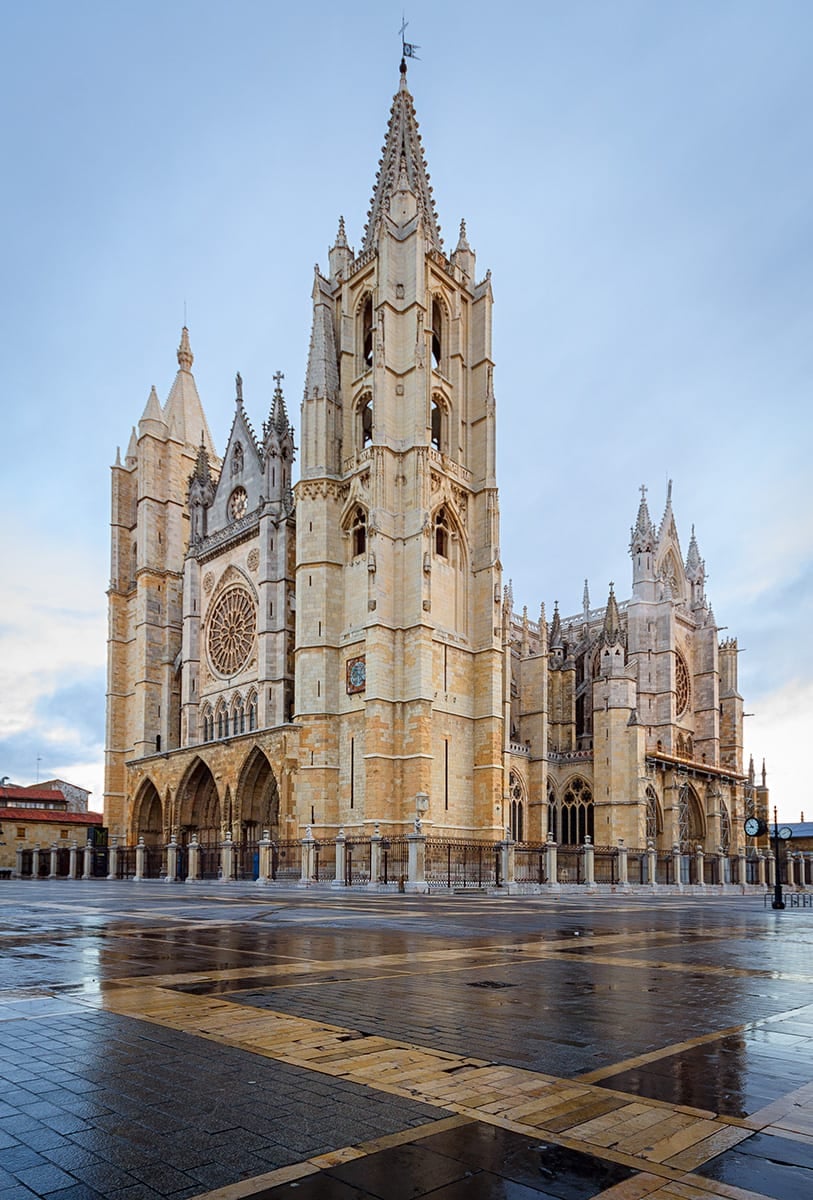
Stepping into León Cathedral is, above all, stepping into light. Here Gothic was taken to its ultimate conclusion: the walls were reduced to a bare minimum and their place was taken by coloured stained glass. As a result, the cathedral houses one of the largest collections of medieval stained-glass windows in the world.
Art historians speak of the "dematerialisation" of Gothic to describe that sense of stone giving way to glass, and rarely is it understood as clearly as it is here. Simply stand still beneath the naves for a few minutes to watch the colour spill across the interior and shift as the day goes on.
It is no coincidence that it is known as the Pulchra leonina, the "Beautiful Leonese". Construction began in the 13th century, and the result is one of the great creations of Peninsular Gothic, with a clear French influence evident in the lightness and verticality of the whole building.
The cathedral is dedicated to the Virgin Mary under the title of Santa María de Regla, and today it remains the episcopal see of the Diocese of León and a fully active place of worship, something worth bearing in mind so you can visit respectfully. It also stands right on the Camino de Santiago, making it one of the most memorable stops on the pilgrimage route for many pilgrims.
A fact to show off during the walk: it was the first building to be declared a monument in Spain, by a Royal Order of 28 August 1844, confirmed the following year. Few heritage credentials carry as much weight.
Second stop: San Isidoro, the great treasure of Romanesque
After about 380 metres on foot, the scene changes completely. If the cathedral is all verticality and light, the Royal Collegiate Church of San Isidoro is intimacy, solidity and colour painted onto stone. It is one of those places that offer a glimpse of Romanesque with an intensity hard to find anywhere else.
Its jewel lies at the foot of the church: the Royal Pantheon, which preserves Romanesque wall paintings and original capitals, and is therefore considered unique in the Romanesque world of its time. Architecture, sculpture and colour come together here as in very few places, so it deserves an unhurried visit, with your eyes raised towards the vaults.
The complex was built and extended throughout the 11th and 12th centuries and ranks among the most outstanding examples of Romanesque in Spain, both for its history and its fabric and for the luxury objects from the period that have survived to this day. Its origins are even older than they seem: before becoming what we see today, it was a monastery dedicated to San Pelayo, and it is believed that there was even a Roman temple beneath its foundations.
The change of name came with the transfer to León of the remains of Saint Isidore, Bishop of Seville, known as the Doctor of the Spains. Since then the church has been dedicated to him, forever linked to the memory of the scholar from Seville.
Before moving on, spend a while outside and take a look at the doorways. On the south façade are the Puerta del Cordero (Lamb Doorway) and the Puerta del Perdón (Pardon Doorway), and to the north the Puerta Capitular (Chapter Doorway). Together with the Pantheon, they are the earliest expressions of Romanesque art in the lands of León. Some traces of the original building promoted by Ferdinand I and Sancha still remain in the church, a reminder of the many layers of history overlapping in this building.
Third stop: the castle, a citadel with many lives
Just 180 metres further on, we reach the end of the route: León Castle. It is a different kind of stop from the great churches, and that is precisely why it rounds off the route so well.
In medieval documents it is referred to as the towers of León, a name that already hints at its nature. Rather than an isolated castle perched on a hilltop, it is a fortified enclosure tied to the city itself, designed for its defence and control. That is why it is described as a citadel rather than simply a fortress, a nuance worth keeping in mind as you approach.
What is fascinating about the castle is its capacity for reinvention. Over time, its walls housed the local prison, a fate shared by many historic fortifications whose solid, enclosed spaces were ideal for the purpose. It is a less pleasant chapter, but just as revealing.
The current phase began in 1982, when the castle became home to the Provincial Historical Archive of León. The place that once guarded the city, and later its prisoners, now safeguards documents: the written memory of the province. Seen this way, its story is almost a miniature history of León itself.
Tips for planning your visit
- When to go. The best times are spring and autumn, from April to June and from September to October. Summers are mild, but winters are cold, so if you travel in the harshest months, bring a good coat.
- Comfortable shoes. Although the distance is short, you will spend a lot of time on your feet inside the monuments and walking the streets of the old town.
- Play with the light. In the cathedral, light is everything. If you can, take time to watch the colours of the stained glass change; a sunny day makes the experience even more memorable.
- Respect worship. The cathedral is still an active place of worship, so keep quiet and be discreet.
- Get up early on holidays. On long weekends and special dates, arriving early helps you enjoy the monuments at a more relaxed pace.
- Set aside time for the Pantheon. It is easy to underestimate; don't. Its paintings demand that you stop.
A short walk for a long history
In little more than half a kilometre, this route sums up much of what makes León special: the Gothic light of the Beautiful Leonese, the strength of Romanesque at San Isidoro and the changing memory of a citadel turned archive. Three stops, three eras and one city that can be read step by step. Rarely does such a short walk offer so much.
Full route
Castile and León walking route: León Cathedral - León Castle →3 stops · 0.56 km, with an itinerary map and navigation.
Article written with the help of artificial intelligence based on Wikipedia (CC BY-SA 4.0) and our catalogue, and reviewed by the El Trotamundos Curioso team.
Keep reading
The Catalan Pyrenees: Romanesque churches, monasteries and mountain villages from the Vall de Boí to the Ripollès

From Segorbe to Alicante by car: a Valencian Community road trip of cathedrals, monasteries and castles