From Riner to Roses: a road trip through Catalonia's monasteries, castles and a Greek citadel
168 km across Catalonia: from the Monastery of El Miracle to the Citadel of Roses, via Cardona, Sant Joan de les Abadesses and Girona Cathedral.
In this article
Some routes are travelled by watching the landscape; others by watching time go by. This is one of the latter. In just 168.4 kilometres of road, from the heart of the Solsonès to the Gulf of Roses, you'll cross a thousand years of Catalan history… and then some, because the final stretch leaves you facing the remains of a colony founded by the Greeks. Monasteries that are still very much alive, what is probably the most important medieval fortress in Catalonia, a cathedral that holds a world record and a Renaissance citadel built over ancient Rhode. The perfect plan for a long weekend or a few unhurried days.
The route at a glance
The route heads from west to east, from the inland territories to the Mediterranean. These are the stops, in order:
- Monastery of El Miracle (Riner, Solsonès): starting point.
- Cardona Castle: 13.2 km.
- Monastery of Sant Joan de les Abadesses (Ripollès): 60.9 km.
- Cathedral of Santa Maria of Girona: 52.2 km.
- Citadel of Roses: 42.1 km, end of the route.
The longest leg is the one linking Cardona with Sant Joan de les Abadesses; the rest are easy drives that let you give each stop the time it deserves. If you can, spread the route over two or three days: you'll be glad you did.
Monastery of El Miracle: Benedictine silence in the Solsonès
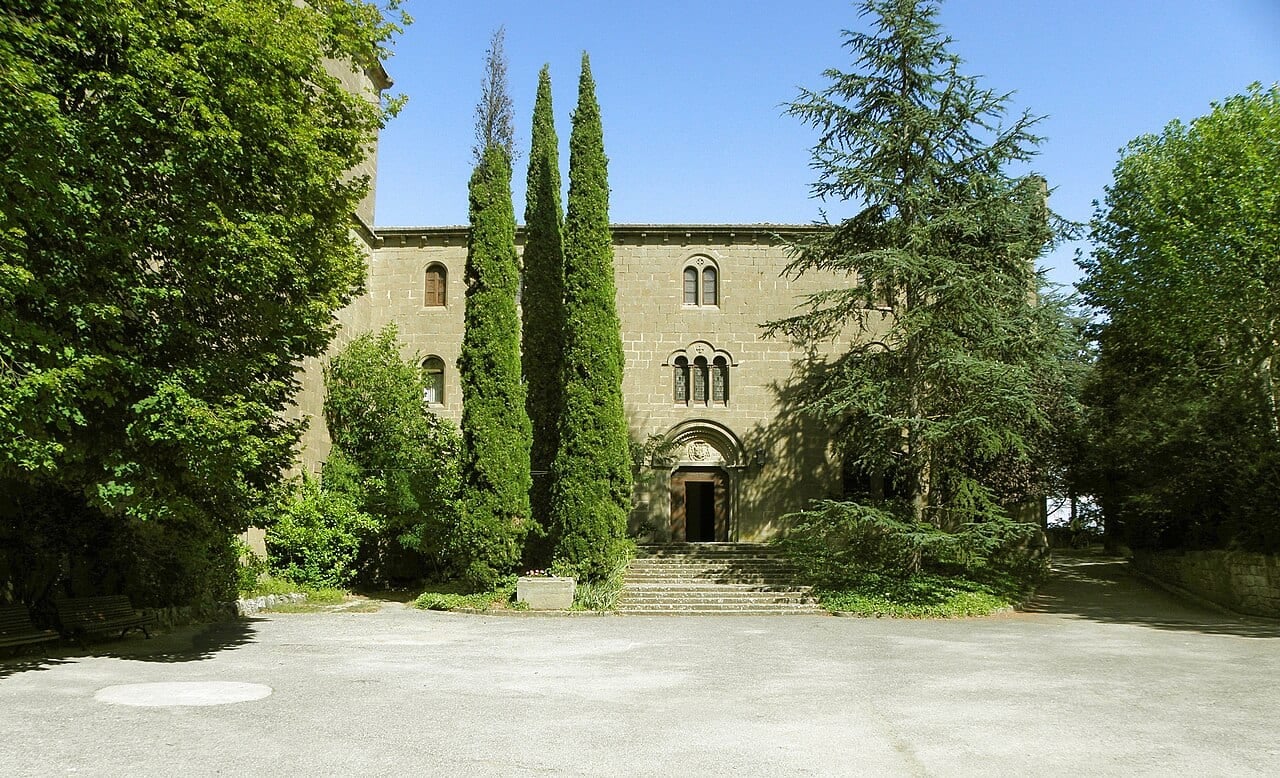
We start in Riner, in the Solsonès district, home to the Monastery of El Miracle, known in Catalan as the monestir del Miracle. It forms part of the Miracle sanctuary complex and is a Benedictine monastery that still fulfils its original purpose today: it is home to a small community of four monks who answer to the Monastery of Montserrat.
That gives it a special atmosphere. This is no monument frozen in the past, but a living place, and it should be visited with the respect and calm that this calls for. It makes a fine start to the route: a first taste of inland Catalonia, the Catalonia of sanctuaries and monastic life, before hitting the road.
Cardona Castle: the giant above the salt valley
Just 13.2 kilometres away lies the most imposing stop of the day. Cardona Castle, in the province of Barcelona, is probably the most important medieval fortress in Catalonia, and one look at it from afar is enough to see why.
It stands on a hill overlooking two landscapes at once: the salt valley and the Cardener valley. Its position says everything about its historical role: from up there, the surrounding territory and everything that passed through it could be controlled. Allow plenty of time for the climb, take in its silhouette and don't miss the views over the valleys, which are an essential part of the experience.
A practical tip: wear comfortable shoes, as hilltop fortresses always mean slopes and the odd uneven stretch.
Monastery of Sant Joan de les Abadesses: the monastery of women
Now comes the longest leg of the route, almost 61 kilometres north into the Ripollès district. There, in the town that bears its name, stands the Monastery of Sant Joan de les Abadesses (monestir de Sant Joan de les Abadesses).
Its history has a hook that's hard to beat: until the year 945 it was the only convent in Catalonia. The very name of the town, "of the Abbesses", preserves the memory of the women who governed it. It's one of those places where it's worth pausing to imagine what life was like in such a community more than a thousand years ago.
This visit wraps up the most inland and mountainous part of the trip before you head down towards Girona.
Cathedral of Santa Maria of Girona: the widest Gothic nave in the world
After 52.2 kilometres you reach Girona, and the first thing to look for is its highest point: that's where you'll find the Cathedral of Santa Maria, the city's main Catholic church.
Its great treasure is a record: it has the widest Gothic nave in the world, measuring 22.98 metres across. Step inside and the sense of space is overwhelming; there are no columns dividing it, just a single enormous vault.
The cathedral is also an art history book in stone. Construction began in the 11th century in the Romanesque style and continued in the 13th century in the Gothic style, though it wasn't completed until the 18th century. Only two pieces survive from the Romanesque period, and both deserve your attention:
- The tower, dating from 1040.
- The cloister, from the 12th century.
It is listed as a Site of Cultural Interest (bien de interés cultural). And if you're left wanting more, right next door is the former Bishop's Palace, now home to the Girona Art Museum.
Citadel of Roses: from Greek colony to fortress of Charles I
The final 42.1-kilometre leg takes you to the sea, to the Gulf of Roses, at the north-eastern tip of the Spanish coast. This is where the route ends, at the Citadel of Roses, the walled enclosure that once protected the town.
Its history begins long before the walls. Roses was founded as a Greek colony under the name of Rhode, and several mysteries surround it. The resemblance to the island of Rhodes is obvious, but there's no proof that the two names are related, nor that its founders were Rhodians. Nor is there agreement on the date: literary sources speak of the 8th century BC, whereas archaeology links it to nearby Emporion (Empúries) and dates it no earlier than the 5th century BC. Both colonies also shared the cult of Artemis.
There is, however, one intriguing clue: the drachmas minted in Rhode around 400 BC, bearing the inscription ΡΟΔΗΤΩΝ, resemble neither those of Emporion nor those of Massalia (Marseille), but rather the style of Rhodian coins.
What you see from the outside today is the remodelling ordered by King Charles I in 1543, when he visited the town, to protect it from pirate raids and the French. It has been a Site of Cultural Interest since 1961. A perfect finale: twenty-five centuries of history beside the Mediterranean.
When to go and tips for planning the route
The best time to do this route is spring or autumn, when temperatures are pleasant both inland and on the coast, although the coastal area can be visited almost all year round.
A few recommendations:
- Comfortable shoes: hilltop castles, cathedrals with flights of steps and walled enclosures call for good soles.
- In summer, avoid the middle of the day, especially in Cardona and Roses.
- On public holidays and long weekends, arrive early at the busiest sites, such as Girona.
- Respect the silence in the monasteries, especially at El Miracle, where a community lives.
- Don't rush: the kilometres are few, but the history is plentiful. Better two or three days than one against the clock.
From a Benedictine sanctuary to a Greek colony: few routes pack so much into so little road.
Article written with the help of artificial intelligence based on Wikipedia (CC BY-SA 4.0) and our catalogue, and reviewed by the El Trotamundos Curioso team.