From La Macarena to the Cathedral: a walk through the soul of Seville
From the Esperanza Macarena to the Giralda in 2.55 km: brotherhood devotion, Baroque painting, the old Port of the Indies and the world's largest cathedral.
In this article
Some walks help you get to know a city; others help you understand it. This walking route through Seville belongs to the latter: in just 2.55 kilometres it crosses the historic centre from north to south, linking four stops that, together, tell a good part of the story of the Andalusian capital. The brotherhood devotion of the Macarena district, the splendour of Baroque painting, the memory of the port that looked out towards the Americas and, as a grand finale, a cathedral beyond compare.
The distance is manageable for almost anyone, so the pace is set by the visits rather than your legs. It's worth setting aside a good part of the day, especially if you want to take your time in the museum and the cathedral.
The route at a glance
- Basilica of La Macarena, the starting point in the north of the Old Town.
- Seville Museum of Fine Arts, 1.45 km from the basilica.
- Chapel of La Pura y Limpia, 0.93 km from the museum, in El Arenal.
- Seville Cathedral, just 0.17 km from the chapel.
The first stretch is the longest; from then on the stops get closer together, and the final leg, between the chapel and the cathedral, is over in the blink of an eye.
Basilica of La Macarena: the heart of Holy Week
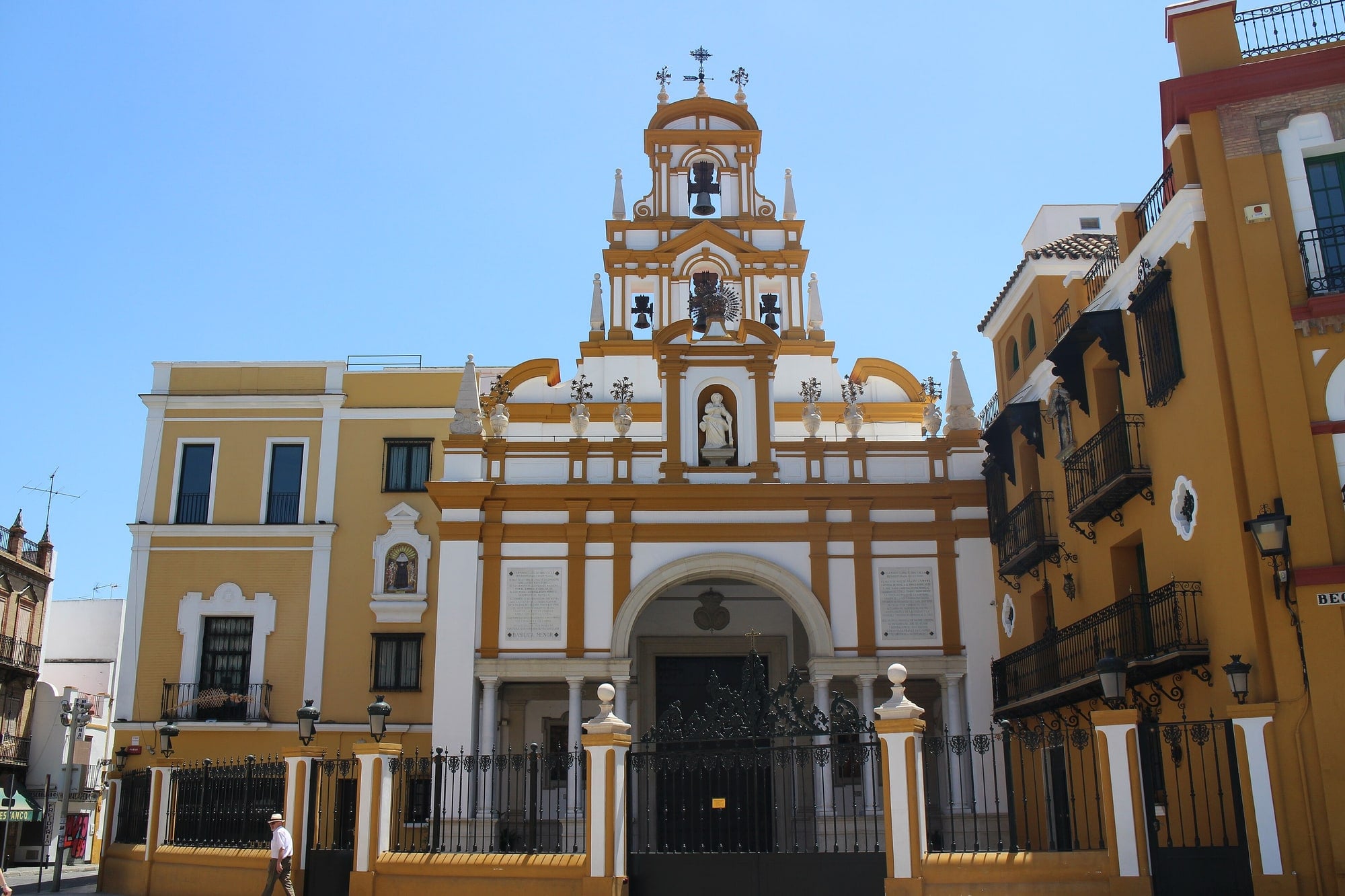
Some churches are visited for their architecture and others for what they mean, and the Basilica of La Macarena belongs firmly in the second category. Its official name is the Basilica of María Santísima de la Esperanza Macarena, and it stands on Plaza de la Esperanza Macarena, in the district that gives it its name, beside the Ronda Histórica and just inside the Old Town. It's a setting where neighbourhood life and brotherhood tradition go hand in hand – a fine place to start getting a feel for the city.
This is the home of the Esperanza Macarena, one of the images that best sums up Sevillian devotion. The basilica is the seat of the Brotherhood of the Esperanza Macarena, one of the most deeply rooted brotherhoods in Seville, and every year its penitential procession sets out from here during the Madrugada of Good Friday, the most eagerly awaited night of Holy Week.
The Virgin does not process alone: she is accompanied by Nuestro Padre Jesús de la Sentencia, the brotherhood's other great titular image. Seeing them in their church, calmly and away from the bustle of the streets, lets you appreciate them up close and understand the emotion they stir when they pass through the district in the small hours. It's well worth going in without rushing, whether you're a believer or not.
On the way to the Museum of Fine Arts
From La Macarena comes the longest stretch of the route, almost a kilometre and a half through the historic centre. It's a good moment to let the streets carry you along, take in the façades and arrive keen for the second stop.
Before going into the museum, pause in Plaza del Museo, the pleasant square that opens out in front of the façade. It is presided over by a sculpture of Bartolomé Esteban Murillo – a fitting touch, as the Sevillian painter seems to welcome those who come to see his canvases.
Museum of Fine Arts: the golden age of Sevillian painting
Anyone wanting to understand Sevillian Baroque painting simply has to stop here. The museum brings together the finest work of Zurbarán, Murillo and Valdés Leal, the three great names of the city's golden century, and rounds off the visit with a notable collection of 19th-century Andalusian painting. Not for nothing is it considered one of the most important art galleries in Spain.
The building is part of the experience. The museum occupies the former Convent of La Merced, one of several convent buildings left empty after the disentailment and chosen in 1839 to house the collection. The works are thus displayed in a space that preserves the memory of its religious past, giving the galleries a special charm.
Its history begins with a Royal Order of 16 September 1835, which created it under the name of the "Museo de Pinturas". It officially opened its doors in 1841, so it has almost two centuries behind it. In 1962 it was declared a historic-artistic monument, and today it is protected as a site of cultural interest in the monument category.
Chapel of La Pura y Limpia: a hidden gem in El Arenal
After just under a kilometre you reach El Arenal, the district that stretches towards the river. There, on Calle Almirantazgo and next to the Postigo del Aceite, stands the Chapel of La Pura y Limpia, a small 18th-century church that many people walk straight past. It would be a shame to do so.
Its value lies not in its size but in what it represents. For centuries, Seville was dotted with street chapels dedicated to the Immaculate Conception, places for a passing prayer woven into neighbourhood life. Today only a handful remain: this is one of the few survivors, along with those in the Patio de Banderas and on the cathedral steps. Visiting it is a glimpse into an urban landscape that has all but vanished.
The surroundings add to the interest. The chapel stands in what was once the old Port of the Indies, the commercial heart of a Seville turned towards the Americas, and it adjoins the Postigo del Aceite, one of the city's old gates, which in turn borders the Royal Shipyards (Reales Atarazanas). Pause for a few minutes and you can picture the comings and goings of goods, sailors and merchants. If you have time, take a proper look at the Postigo and the Atarazanas to understand how port activity and popular religion coexisted here.
Seville Cathedral: the grand finale
A mere 170 metres separate the chapel from the last stop, and few visits in Spain are as impressive. In 1988 Guinness World Records certified it as the cathedral with the largest surface area in the world, and its scale strikes you the moment you cross the threshold. Gothic in structure and enriched with Renaissance additions, it forms part of the ensemble that UNESCO declared a World Heritage Site in 1987, together with the Real Alcázar and the Archivo de Indias.
It was built on the site of the great mosque, which had served as a Christian church for more than a hundred and fifty years and was badly deteriorated. Two of Seville's emblems survive from it: the minaret, transformed into the Giralda, whose uppermost section was built by Hernán Ruiz, and the Patio de los Naranjos (Courtyard of the Orange Trees), a shady haven that's ideal for ending the route.
Tradition dates the start of construction to 1401, although documents do not mention the works until 1433. Among the first master builders was Maestre Carlín, a Norman seasoned on other great European cathedrals who, it is believed, came fleeing the Hundred Years' War. On 10 October 1506 the last stone was laid at the top of the crossing tower, but work continued under Diego de Riaño, Martín de Gainza and Asensio de Maeda until the ensemble was completed in 1593.
Tips for planning the walk
- When to go: the best time is from October to May. In July and August the Sevillian heat can be extreme; if you have no choice, walk first thing and avoid the middle of the day.
- Footwear and water: the distance is short, but between walking and visits you'll spend many hours on your feet. Wear comfortable shoes and bring some water.
- Divide your time: the museum and the cathedral deserve a leisurely visit; the chapel, on the other hand, is a brief stop you can enjoy in a few minutes.
- On special dates: during Holy Week the area around La Macarena and the centre are completely transformed. It's a unique experience, but be prepared for crowds and bring your patience.
From the Esperanza to the Giralda, this walk distils centuries of Sevillian history into one well-spent morning or afternoon. Few routes this short offer so much.
Full route
Andalusia walking route: Basílica de la Macarena - Seville Cathedral →4 stops · 2.55 km, with an itinerary map and navigation.
Article written with the help of artificial intelligence based on Wikipedia (CC BY-SA 4.0) and our catalogue, and reviewed by the El Trotamundos Curioso team.