From Estella to Getaria: a road trip through the convents, sanctuaries and Gothic churches of Navarre and Gipuzkoa
A 95.5 km road trip from the Convent of Santo Domingo in Estella to San Salvador in Getaria, taking in Arantzazu, Antio and Zarautz.
In this article
Some routes are planned around the scenery and others around the heritage. This one, linking the Convent of Santo Domingo in Estella with the Church of San Salvador in Getaria, manages both: over 95.5 kilometres of road you go from the banks of the Ega to the mountains of Oñati and, from there, down to the Gipuzkoan coast. Along the way you'll find a sanctuary that dared to embrace modern art, a wooden hermitage built without a single nail, an unassuming village church and two Gothic churches that hold much of Gipuzkoa's history.
The route at a glance
Here are the six stops, in order, with the distance from the previous one:
- Convent of Santo Domingo (Estella, Navarre)
- Sanctuary of Arantzazu (Oñati, Gipuzkoa) – 45.9 km
- Hermitage of Santa María de la Antigua (Zumarraga) – 14.7 km
- Church of San Martín de Tours (Alkiza) – 18.2 km
- Church of Santa María la Real (Zarautz) – 13.8 km
- Church of San Salvador (Getaria) – 2.9 km
The first leg is the longest; from Arantzazu onwards the hops are short, and the last one, between Zarautz and Getaria, is barely more than a stroll.
Convent of Santo Domingo: a bird's-eye view of Estella
The starting point announces itself from afar. The former Convent of Santo Domingo, which is also referred to as the Convent of the Preachers (worth knowing if you're tracing its history in guidebooks or documents), stands on a hill above the River Ega and offers one of the most commanding views over Estella. It no longer serves as a convent, but its silhouette remains a constant landmark for anyone wandering around this town in Tierra Estella.
The best thing about the place is its setting: from up high you can see at a glance how the river, the town and the building itself fit together. It's the ideal spot to start the day by taking in the bigger picture, at an unhurried pace, before heading north.
Sanctuary of Arantzazu: age-old devotion, 20th-century art
At 750 metres above sea level, surrounded by mountains and greenery, the Sanctuary of Arantzazu takes visitors climbing up from the Oñati valley by surprise. Its origins are steeped in legend: according to tradition, the Virgin appeared here in 1468, and ever since the site has been a focal point of Marian devotion. Today the Virgin of Arantzazu (Aránzazu in Spanish) is the patron saint of Gipuzkoa.
The Franciscans have looked after the church since 1514, more than five centuries of presence that account for the place's serene character. And yet what first catches the eye is its basilica, built in the 1950s, where architecture, sculpture and painting come together thanks to internationally renowned artists. Rarely has a traditional place of pilgrimage been dressed in such a modern and ambitious language.
A curious detail: this devotion travelled far, to the Philippines, Argentina and Mexico, proof of how deeply rooted it is.
Hermitage of Santa María de la Antigua: the cathedral of Basque hermitages
In Zumarraga it's simply called Antio, and what leaves you speechless on entering is its wooden interior. Six stone columns support an oak framework that forms a projecting choir and holds up part of the roof. Beams, parapets, tie beams and corbels are joined by tongue and groove, without nails or screws. It is one of the most important works of carpentry in the Basque Country.
It's worth looking up: the wood is carved with women's heads, tools and geometric motifs rooted in folk art, the same ones found on kutxas (chests) and argizaiolas. The choir was completed in 1524 and originally reached halfway along the church, before taking on its current U shape.
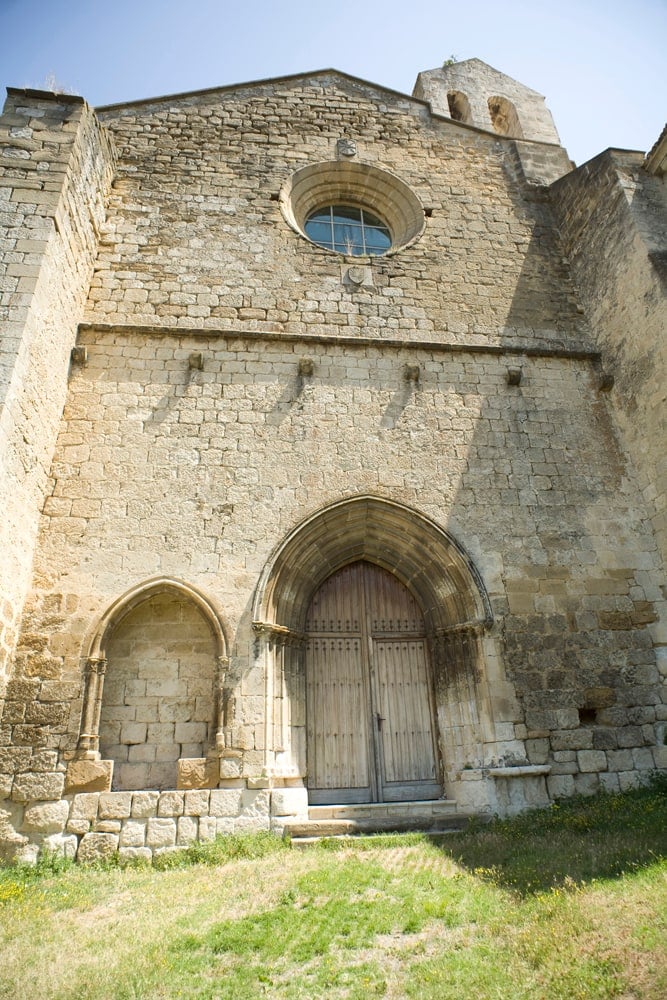
The single-nave building sits on the southern slope of Mount Beloki and dates from the late 12th or early 13th century. Its Romanesque doorway has a slightly pointed arch with four archivolts, alongside a Gothic window; the trapezoidal apse was added in 1480. It was Zumarraga's parish church until 1576, when a new church was built in the town centre and this one became "the old one". This is where Miguel López de Legazpi, the discoverer of the Philippines, was baptised – a nod that ties in with the devotion to Arantzazu on those islands.
Church of San Martín de Tours: the charm of the understated
The stop in Alkiza is the quietest on the route. Its church, dedicated to St Martin of Tours, is one of the village's most representative buildings and a good way to understand the role these churches have played in the life of Gipuzkoa's small villages.
There is little information available, which is all the more reason to discover it in person: take in its exterior, how it relates to its surroundings and the atmosphere of the place. A tip: ask locally about getting inside, as in many village churches it depends on service times or on whoever keeps the keys.
Santa María la Real: the history of Zarautz in a single complex
Now on the coast, almost at the gates of Zarautz if you're coming from Getaria, stands this 15th-century church in the Spanish Gothic style. Inside, your eye goes straight to the main altarpiece, dating from the late 16th and early 17th centuries, begun by Andrés de Araoz and his son Juan and designed to frame the Gothic image of Our Lady la Real. Don't miss the two altars attributed to Ambrosio de Bengoechea, one dedicated to the Virgin of the Rosary (1612) and the other to St Exuperius, or the rose window with its 19th-century stained glass on the west wall.
The parish church is part of the Santa María la Real Monumental Archaeological Complex, together with the Zarautz Tower (Torre Zaratz), which dates from the 15th century and is considered the oldest building in the town. The bell tower houses the Museum of Art and History, and the remains of Zarautz's first necropolis were discovered beneath the church walls.
San Salvador in Getaria: a fitting finale
The route ends less than three kilometres away, at a church that surprises you the moment you step through the door: the floor isn't level. The church follows the slope of the land, and its different levels, with the raised presbytery, create a most unusual perspective. Above, an openwork triforium runs around the whole interior and rib vaults crown a three-nave Gothic space.
Its historical significance is huge: the first General Assembly (Juntas Generales) of Gipuzkoa was held here in 1397, and Juan Sebastián Elcano was probably baptised in its font. It has been declared a National Monument. Although documented since the 14th century, most of the building, in sandstone ashlar, went up between the 16th and 18th centuries. Take a look at its two towers: the truncated north tower, known as the Inquisition Tower, is the oldest; the other, six storeys high and designed by Pedro de Alzaga, took from 1525 to 1755 to complete, and barely five years later lightning destroyed its upper section. Before you leave, look out for the Katrapona Passage.
Tips for planning the route
- When to go: for the Gipuzkoa stretch, May to September is ideal, when rain is less frequent. Estella is at its best in spring and early autumn, so late spring or September strike a good balance.
- Time: it can be done in one long day, but spreading it over two lets you enjoy Arantzazu and the coast at a leisurely pace.
- Footwear: comfortable, for the climb up to the convent in Estella and for Getaria's steep streets.
- Access: at the smaller churches, check beforehand whether you can visit the interior, and on public holidays arrive early at the busiest spots.
From the Ega to the Bay of Biscay, this route proves that less than a hundred kilometres can hold centuries of history, faith and fine craftsmanship.
Article written with the help of artificial intelligence based on Wikipedia (CC BY-SA 4.0) and our catalogue, and reviewed by the El Trotamundos Curioso team.